Electric bikes are often associated with commuting, but they can be even more useful once the weekend arrives. A Saturday ride may begin as a short trip through the neighborhood and gradually turn into a longer route through parks, country roads, waterfront paths, or nearby trails. This is where battery range starts to matter.
A standard e-bike may be perfectly adequate for short errands and daily transportation. However, weekend riders often travel farther, encounter more hills, carry extra gear, and spend more time away from convenient charging points. A long-range e-bike gives riders more freedom to explore without constantly checking the battery display or planning the entire day around a charging stop.
Long range is not only about covering the greatest possible distance. It can also make recreational riding more flexible, comfortable, and practical.
More Freedom to Explore
One of the main reasons people choose an e-bike for weekend trips is the freedom to travel beyond their usual routes. Instead of staying close to home, riders can connect several bike paths, visit a neighboring town, ride around a lake, or explore roads that would feel too demanding on a traditional bicycle.
A larger battery gives riders more room to change their plans along the way. They can take an unexpected detour, stop at another destination, or extend the ride when the weather and scenery are good.
This flexibility is especially valuable when the return trip is just as long as the ride out. It is easy to underestimate how much battery will be needed after riding for several hours, especially when the second half of the journey includes hills, wind, or rougher surfaces.
With more available range, riders do not have to treat every mile as part of a strict battery budget.
Less Range Anxiety
Range anxiety is not limited to electric cars. E-bike riders can also become concerned when the battery level begins dropping far from home.
That concern can change the entire riding experience. Instead of enjoying the surroundings, the rider starts reducing assistance, avoiding hills, or searching for a place to recharge. A weekend trip that was supposed to feel relaxing can quickly become a battery-management exercise.
A long-range electric bike provides a larger safety margin. Even when the planned route is well within the advertised range, the extra capacity can help account for changing conditions.
This does not mean riders should ignore the battery display or leave home without planning. It simply means there is more room for unexpected mileage and less pressure to use the lowest assistance level throughout the trip.
Weekend Routes Are Harder to Predict
Daily commuting routes are usually consistent. Riders know the distance, road conditions, traffic patterns, and approximate amount of battery required.
Weekend rides are less predictable.
A recreational route may include a mixture of paved bike paths, gravel roads, grass, hills, and uneven surfaces. Riders may also stop and restart more frequently, carry bags, or ride with friends who prefer a different pace.
All of these conditions can affect battery consumption. Climbing, riding into strong wind, using higher assistance levels, carrying more weight, and moving through loose terrain generally require more energy than cruising on a flat paved road.
For this reason, a rider planning a 40-mile trip may benefit from choosing a bike rated for considerably more than 40 miles. The additional capacity creates a practical reserve rather than forcing the rider to depend on the maximum advertised figure.
More Comfortable Group Rides
Group rides rarely move at a perfectly consistent pace. Some riders climb faster, while others need more assistance to keep up. There may also be repeated stops, route changes, or longer breaks than expected.
A long-range e-bike can make it easier to adjust assistance throughout the day. Riders can use more motor support on hills or when keeping pace with the group without immediately worrying that the battery will not last for the return journey.
This can be particularly useful for couples or groups with different fitness levels. Electric assistance helps reduce the performance gap, while a larger battery makes it possible to maintain that support across a longer route.
The result is often a more enjoyable shared ride. The group can focus on the destination and scenery rather than constantly adjusting the route around the rider with the lowest remaining battery level.
Useful for Carrying Weekend Gear
Weekend rides often involve more than the rider and the bike. A longer trip may require water, food, repair tools, an extra layer of clothing, a lock, a camera, or other personal items.
Some riders may also use an e-bike to reach a picnic area, campsite, fishing spot, local market, or outdoor event. Added cargo increases total weight and can reduce real-world range, particularly on routes with frequent elevation changes.
A long-range model provides more capacity to support both the rider and the additional load. This does not eliminate the need to pack carefully, but it gives the bike more flexibility when the trip involves more than a lightweight day ride.
Before setting out, riders should still check the bike’s maximum load capacity and make sure bags or accessories are properly secured.
Range Is About More Than Battery Size
Battery capacity is important, but it is not the only factor that determines whether an e-bike works well for weekend travel.
Motor efficiency, tire size, riding position, assistance settings, total weight, drivetrain, and terrain all influence how far the bike can travel. A large battery paired with an inefficient setup may not perform as expected, while a well-balanced bike can make better use of its available energy.
Comfort also becomes more important as the number of miles increases. A bike may offer impressive battery specifications, but a stiff ride, uncomfortable saddle, or unsuitable frame geometry can make a long trip unpleasant.
When comparing long-range e-bikes, riders should consider:
- Battery capacity and whether the battery is removable
- Estimated range in both throttle and pedal-assist modes
- Motor power and performance on hills
- Tire width and suitability for the planned surfaces
- Suspension and overall ride comfort
- Brake type and stopping control
- Maximum load capacity
- Bike weight
- Available rack and accessory options
- Charging time
The best option is not always the bike with the highest advertised number. It is the one that combines sufficient range with the comfort, control, and carrying capacity required for the rider’s typical weekend routes.
Fat Tires Can Help on Mixed Surfaces
Many weekend routes do not remain on smooth pavement. Even a mostly paved trip may include gravel parking areas, uneven shoulders, grass, dirt paths, or rough sections of road.
A fat tire electric bike can provide additional stability and traction on these mixed surfaces. Wider tires create a larger contact area with the ground and can help the bike feel more planted when the surface becomes loose or uneven.
Fat tires also add some cushioning, although they should not be treated as a complete replacement for suspension. For riders who regularly move between pavement, gravel, and light trails, combining wider tires with front or full suspension can improve comfort over longer distances.
There is a trade-off. Fat tires, larger frames, and suspension components usually add weight and rolling resistance. This makes battery capacity particularly important. A long-range fat-tire e-bike needs enough energy to support both the extended route and the heavier, more terrain-capable design.
A Practical Example: Puckipuppy Bulldog
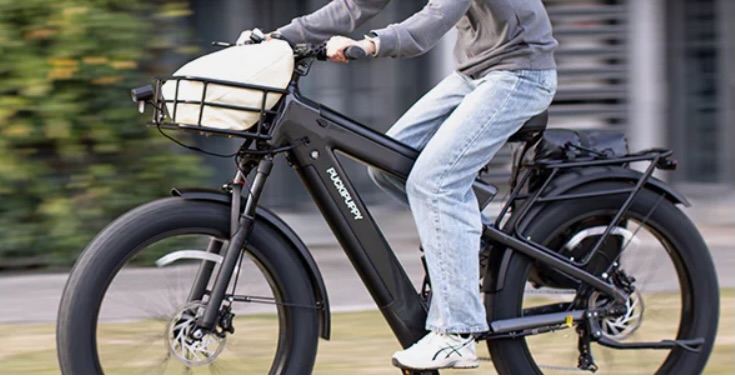
The Puckipuppy Bulldog is one example of an e-bike designed around long-distance outdoor riding. Instead of relying on a single battery, it uses two 48V 15Ah batteries for a combined 48V 30Ah setup. Puckipuppy lists an estimated range of 80 to 130 miles, depending on riding conditions and how the bike is used.
The Bulldog also combines a 750W motor, with a listed peak output of 1,350W, with 26 × 4-inch fat tires and a full-suspension frame. Hydraulic disc brakes, a seven-speed Shimano drivetrain, and a maximum load capacity of 400 pounds support its focus on longer recreational routes and mixed riding surfaces. ion makes the Bulldog more relevant to riders who prioritize endurance, stability, and comfort than to someone looking for the lightest possible e-bike. At 95.5 pounds, it is a substantial machine, so buyers should consider storage, transportation, and handling before choosing it. rips, its main advantage is the dual-battery system. Riders have more capacity available for long routes, higher assistance levels, hills, cargo, and unplanned detours. The fat tires and suspension also make it better suited to routes that combine regular roads with gravel paths, grass, or light trails.
As with any manufacturer’s range estimate, the maximum figure should be viewed as a best-case reference rather than a guaranteed distance. Rider weight, speed, weather, tire pressure, elevation, assistance level, and surface conditions will all affect the actual result.
How to Get More Range on a Weekend Ride
Even with a large battery, a few riding habits can make a noticeable difference.
Start the trip with fully charged batteries and check the estimated route distance before leaving. Use lower or moderate pedal-assist levels on flat sections, saving stronger assistance for hills, loose surfaces, or the later part of the ride.
Correct tire pressure is also important. Tires that are significantly underinflated create additional rolling resistance, while excessive pressure may reduce grip and comfort. Follow the tire and bicycle manufacturer’s recommended range and adjust it for the route conditions.
Smooth acceleration is generally more efficient than repeatedly using maximum motor output from a stop. Riders should also shift into an appropriate gear rather than relying entirely on the motor when climbing.
Cold temperatures can reduce battery performance, so riders planning trips in cooler weather should leave a larger range reserve. Strong winds, heavy cargo, and frequent elevation changes should be treated in the same way.
Plan Around Realistic Range
Advertised e-bike ranges can be helpful when comparing models, but it should not be treated as an exact promise.
Range testing is often conducted under specific conditions involving rider weight, assistance level, speed, terrain, and weather. Real weekend trips may look very different.
A practical approach is to plan around a conservative portion of the advertised range until the rider understands how the bike performs in real conditions. After several rides, it becomes easier to estimate how much battery a familiar route will require.
For example, a rider may learn that a particular bike can comfortably complete 60 miles on mostly flat pavement but uses considerably more energy when the same distance includes hills, loose gravel, and higher assistance settings.
Learning the bike’s real-world range is part of preparing for longer trips.
Do Not Forget Charging and Battery Care
A long-range battery is only useful when it is properly maintained.
Use the charger supplied or approved by the manufacturer, and charge the battery in a dry, well-ventilated area away from flammable materials. Inspect the battery, cables, and charging port regularly for visible damage or unusual heat.
For overnight weekend trips, check whether charging will be available at the destination. A removable battery can make indoor charging more convenient, but riders should confirm that they can safely transport and secure it.
It is also wise to avoid leaving the battery fully depleted for extended periods. Following the manufacturer’s charging and storage instructions can help maintain battery performance over time.
Who Benefits Most from a Long-Range E-Bike?
Not every rider needs the largest available battery. Someone who rides five miles to a café and back may be better served by a lighter and more affordable model.
Long-range e-bikes are most useful for riders who:
- Regularly take recreational rides lasting several hours
- Live far from connected bike paths or outdoor destinations
- Frequently ride on hills or mixed terrain
- Carry bags, supplies, or other cargo
- Prefer using stronger assistance for more of the trip
- Ride with groups covering different routes and distances
- Want a larger battery reserve for unexpected changes
- Use one e-bike for both daily travel and weekend exploration
The value of long range depends on how the bike will actually be used. Extra battery capacity usually adds cost and weight, so it should provide a real benefit rather than simply producing a larger specification.
Final Thoughts
Weekend riding is often less predictable than daily commuting. Routes become longer, surfaces change, gear adds weight, and an unplanned turn can add several miles to the journey.
A long-range e-bike gives riders more flexibility in these situations. It reduces the need to plan every stop around charging and provides a useful reserve for hills, wind, cargo, and changing destinations.
Models such as the Puckipuppy Bulldog take this approach further by combining a dual-battery system with fat tires and full suspension. That type of setup will not be necessary for every rider, but it can make sense for those who regularly spend long days exploring paved roads, gravel paths, and light outdoor routes.
Ultimately, the best long-range electric bike is not simply the one with the largest battery. It is the one that delivers enough realistic range while remaining comfortable, controllable, and suitable for the places the rider actually wants to visit.
Disclosure: I might earn commission from qualifying purchases. We use the commission to maintain the website, buy new products and create content for free, so thank you!